After Class 2
Colonialism and Visual Culture
Today there is no video because I’m on the train, but I am going to write a little something about today’s class, on “Colonialism and Visual Culture”
Also, I should have done this the first time, but I’ll post the syllabus to the bottom of this missive, so the people can see what is coming.
Today we discussed two articles:
Barriendos, Joaquín. “La colonialidad del ver. Hacia un nuevo diálogo visual interepistémico” Nómadas 35 (2011): 13-29. [16 pages]
Darío Yepes, Rubén. “Arte y política: La perspectiva latinoamericana de los estudios visuales.” El Ornitorrinco Tachado 10 (2019): 21-33. [12 pages]
Barriendos discusses the endurance of colonial era visual tropes of monstrosity, in particular cannibalism as related to Indigenous peoples, as one of the key aspects of what he calls the “coloniality of vision”. The text is dense, and at first I asked students to rephrase his two core hypotheses in their own words (as a written do-now assignment), but it was clear that the density of his conceptual framing was a bit much. They didn’t have the context for understanding a critique of colonialism or epistemology. So I had to take a step back and talk about what epistemology means. This is one of the things I really enjoy, actually. Talking about what makes this world what it is, and how it is not the only world, or the only possibility for worlding.
But in trying to describe epistemology, I recalled a phrase that I have used before, and which I think is the clearest most concise way to phrase it. Epistemology is not what we know, but how we know things. How do we know the things we know? That was the question I asked, and I think phrasing it like that allows students to sit with the discomfort of the question, while also being able to see that the question is really a statement, too: we need to critically inquire how the knowledge we take for granted actually came to be. Gender, sexuality, race, “visual culture”. All of these types of knowledge can be interrogated in this way.
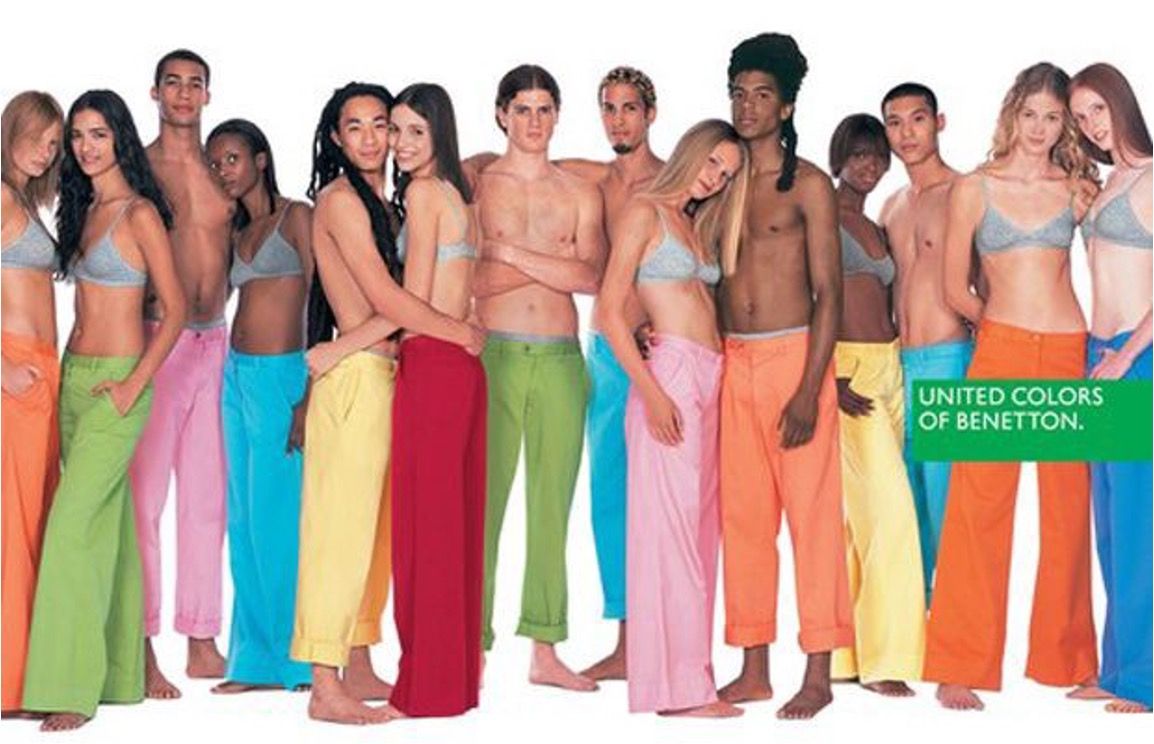
Barriendos makes reference to a continuum that he sees in the coloniality of vision that I found really interesting but also challenging to explain. It was to connect one of Theodore de Bry’s engravings of cannibalism to a United Colors of Benton advertisement. His argument is that one inaugurates the process of optic power that culminates in the other. But this was not particularly clear for students (or me either, to be honest).
- Cannibalism
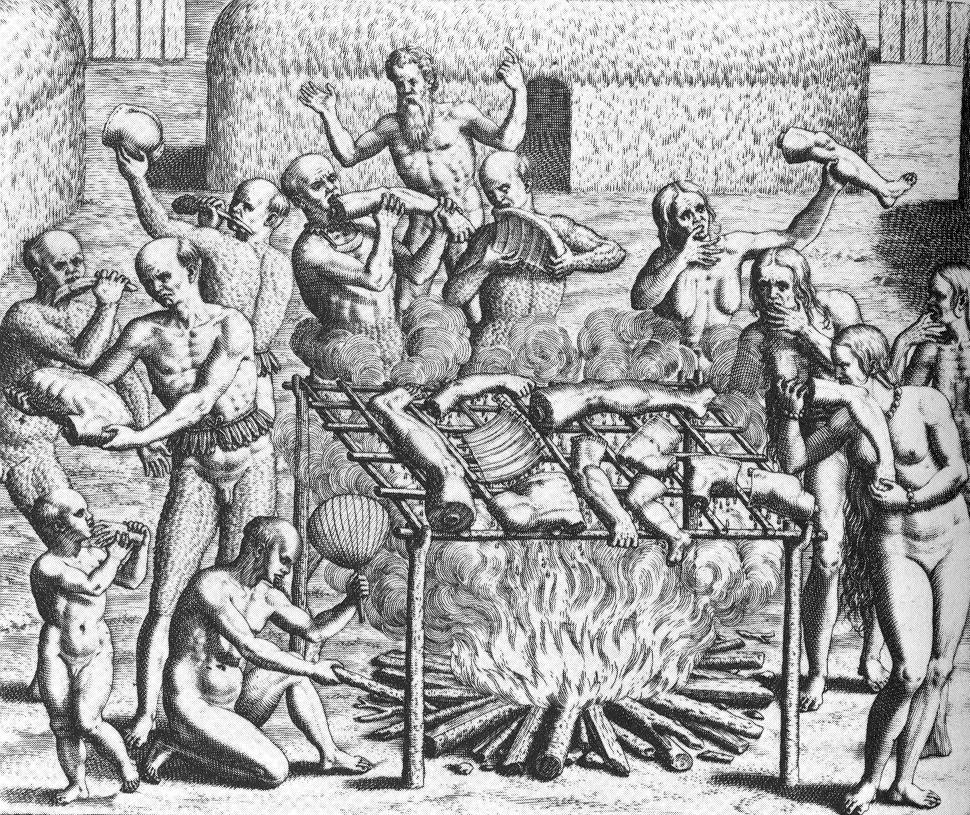
(Cannibalism in Brazil in 1557 as described by Hans Staden (b. around 1525 – Wolfhagen, 1579). Gravure de Théodore de Bry, 1562)
The debate around Indigenous cannibalism became a shorthand for alterity, a radical type of incommensurability that produced the justification for continued colonization, exploitation, and genocide. This much, I think, was clear. But then…
Benneton
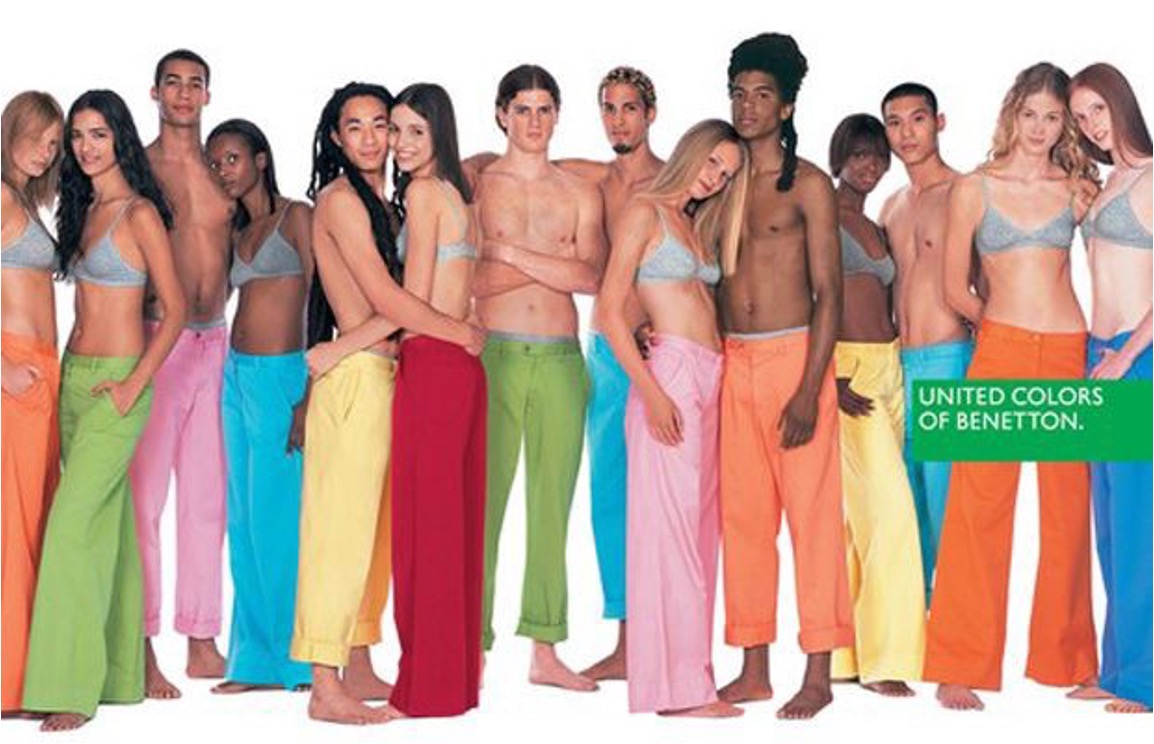
(Oliveiro Toscani for United Colors of Benetton)
It was not that we couldn’t see the multi-culti, everyone is the same, we are all equal, sort of thing, but rather that it took us a second to figure out how to describe the relationship between these two images. The breakthrough came in focusing on the production of alterity in de Bry, which is displaced in the Benetton ad. It is neutralized, or erased, or flattened so as to no longer have meaning. But this lack of meaning only obscures the power dynamics that are opened by the cannibal scene. De Bry produces alterity, Benetton does not alleviate it, but rather, obscures it. The perspective here is crucial. We see this tableau from a singular perspective. The view of power itself, rather than from that of the individual members of the shot. It is an imaginary of equality that is only possible because of the production of race (and racism) in the first place.
Anyway, that was one of the points that we were able to clarify. I think it was important to take a step back and discuss visual culture and visual studies as a field, because they don’t have much experience there, but to do so we hade to take another step back and talk about knowledge production (coloniality) and the power of naming, describing, and ordering the world according to a singular visual regime. I think we figured it out, but I’m going to make sure to circle back on this for next week before we move on.
COURSE CALENDAR
Week 1. 1/26 Viral Visuality: Seeing the World Now
Instagram, Memes, and Tik-Tok (how do you produce/consume images?)
Week 2. 2/2 Anthropology and Photography, Then and Now
Penhos, Marta. “Las imágenes de frente y de perfil, la ‘verdad’ y la memoria. De los grabados del Beagle (1839) y la fotografía antropológica (finales del siglo XIX) a las fotos de identificación en nuestros días.” Mem.soc. 17:35 (2013): 17-36. [19 pages]
Week 3. 2/9 Colonialism and Visual Culture
Barriendos, Joaquín. “La colonialidad del ver. Hacia un nuevo diálogo visual interepistémico” Nómadas 35 (2011): 13-29. [16 pages]
Darío Yepes, Rubén. “Arte y política: La perspectiva latinoamericana de los estudios visuales.” El Ornitorrinco Tachado 10 (2019): 21-33. [12 pages]
Week 4. 2/16 The History of Photography and Anthropology.
Pinney, Christopher. “The Doubled History of Photography and Anthropology” in Photography and Anthropology. London: Reaktion Books, 2011, pp. 17-62. [45 pages]
Week 5. 2/23 Case Studies: Brazil and Argentina
Andermann, Jens. “Spectacles of Sacrifice: Inside the Brazilian Anthropological Exhibition” in The Optic of the State: Visuality and Power in Argentina and Brazil. Pittsburgh: U of Pittsburgh Press, 2007, pp. 58-85. [27 pages]
Masotta, Carlos. “El atlas invisible. Historias de archivo en torno a la muestra ‘Almas Robadas-Postales de Indios’ Buenos Aires, 2010)” Corpus: Archivos virtuales de la alteridad americana 1:1 (2011): 1-31. [30 pages]
Week 6. 3/2 Skin and Sight
Grandin, Greg. “Can the Subaltern Be Seen? Photography and the Affects of Nationalism.” Hispanic American Historical Review 84:1 (2004): 83-111. [28 pages]
Levine, Philippa, “Naked Truths: Bodies, Knowledge, and the Erotics of Colonial Power.” Journal of British Studies 52 (January 2013): 5-25. [20 pages]
Week 7. 3/9 A Historical Detour
Levine, Robert M. “Reading Photographs” in Images of History: Nineteenth and Early Twentieth Century Latin American Photographs as Documents. Durham and London: Duke University Press, 1989, pp. 75-146. [71 pages]
Week 8. 3/16 NO CLASS – SPRING BREAK
Week 9. 3/23 Territorial Expansion and Indigenous Erasure
Tell, Verónica. El lado visible: Fotografía y progreso en la Argentina a fines del siglo XIX. San Martín, Argentina: UNSAM EDITA, 2017. Chapter 1, “Coordenadas de espacio y tiempo. Registros (y ficciones) de la expansión territorial,” pp. 21-64. [43 pages]
Week 10. 3/30 Museum Collections and Eugenic Science
Kerr, Ashley Elizabeth. Sex, Skulls, and Citizens: Gender and Racial Science in Argentina (1860-1910). Nashville: Vanderbilt University Press. 2020. Chapter 3, “Displaying Gender: Indigenous Peoples in the Museo de La Plata,” pp. 66-99. [33 pages]
Week 11. 4/6 [No Class]
Watch Damiana Kryygi on Canopy (2014, Dir. Alejandro Fernández Mouján)
Week 12. 4/13 [Class Online—Special Guest: Giulianna Zambrano]
Week 13. 4/20 Anthropology in Action
Lehmann-Nitsche, Robert. “Estudios antropológicos sobre los Chiriguanos, Chorotes, Matacos y Tobas (Chaco occidental)” Anales del Museo de La Plata. Tomo I. Buenos Aires: Museo de La Plata, 1908, pp. 1-197. [196 pages]
Week 14. 4/27 Decolonial Redux
Rivera Cusicanqui, Silvia. Ch’ixin Akax Utxiwa: Una reflexión sobre prácticas y discursos descolonizadores. Tinta Limón, 2010. “Sociología de la Imagen. Una visión desde la historia colonial andina,” pp. 19-51. [32 pages]
Week 15. 5/4 Conclusion