An Indian Smiling II


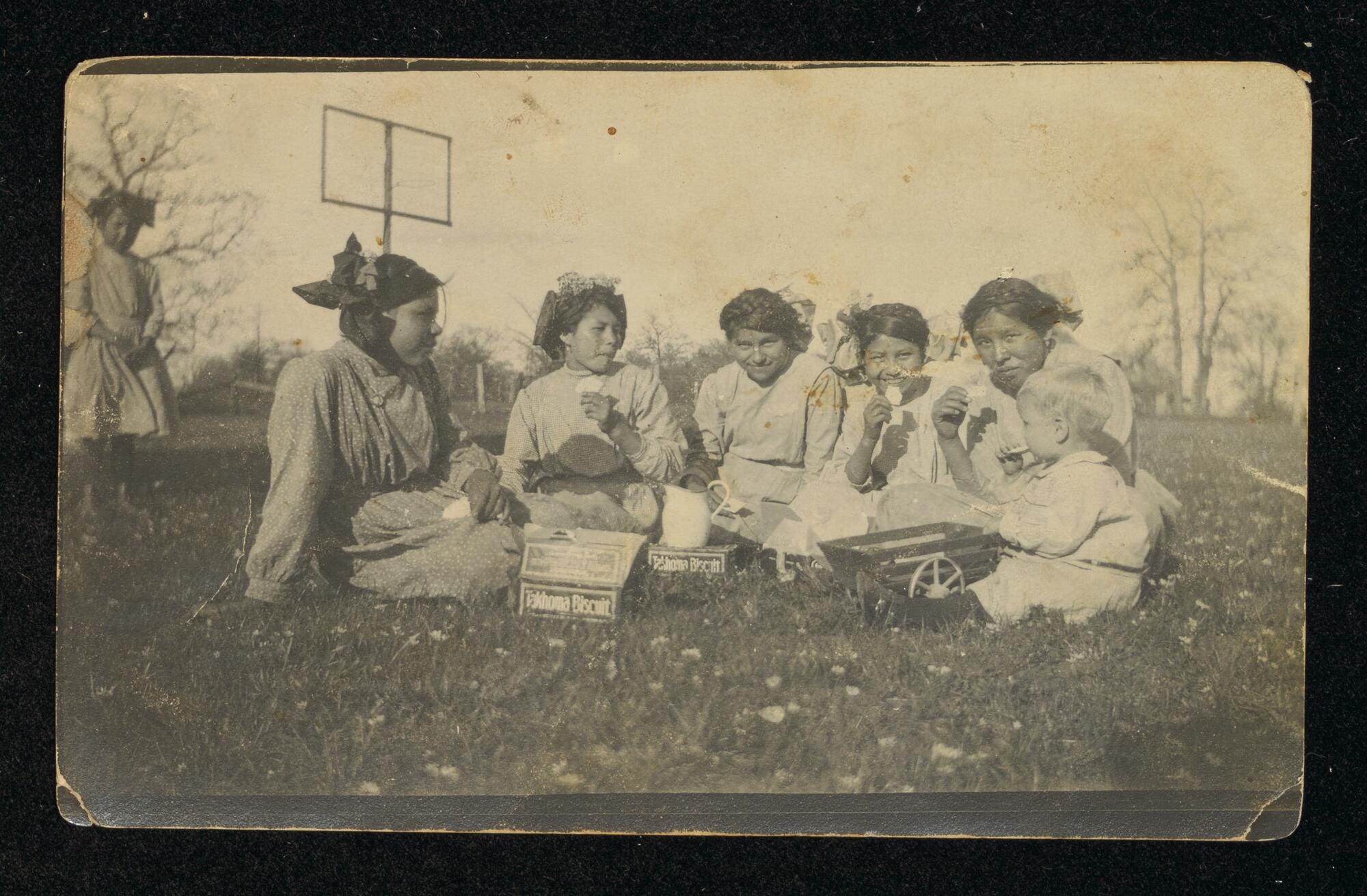
Mary smiles. She's eating water crackers with her friends at the Sac and Fox boarding school near Stroud, Oklahoma. She smiles and they smile watching her smile. She smiles holding a "Takhoma Biscuit," one carton sits open, another sits underneath a pitcher of water or milk.
Their hair is braided in two long plaits and tied above their heads with large bows--black and multicolor ribbons framing their faces. They wear similar uniforms, drab and matronly, despite their youth.
At the far left, a young classmate folds her hands and looks in their direction, slightly blurred at the edge of the frame.
To the right, a blond toddler sits with a toy wagon, leather shoes and black stockings plopped on the grass as he bites into the cracker. It is unclear whose child he is--perhaps he belongs to the schoolmistress, perhaps a teacher has brought her white son to play with the Indians for the afternoon, perhaps not. His name, Carl Tuell, is given on the back, along with the rest of the group:
"Clara having big eat long time ago during King William's War. From left to right: Bessie Grant, Mary McKosito, Ione Bass, Mary Brown, Clara Falls, Carl Tuell"--Back of postcard.
The image is a postcard in the Newberry Library's collection, which gives 1910 as a possible date. The postcard is part of an archive collected by Clara Falls, Clara, who here sits between Mary, who smiles, and Carl, the toddler.
Clara is not smiling, but rather looks circumspect, almost annoyed, at the person taking the photograph.
Mary steals the show. With a full faced smile, teeth bared, cracker nibbled on, fingers grasping its corner, hand casting a shadow across her dress. We can see her gums she is smiling so much.
There are flowering dandelions in the grass beneath these girls.
King William's War was fought between New France and New England between 1688–1697. So it makes no sense as a point of reference in the caption given on the back of the postcard. Unless the reference is to a kind of generic "Indian War" and that was the one that came to mind. But still, this image came more than 200 years later.
The photograph is composed nearly in thirds. The horizon behind the group doesn't quite split the frame and it doesn't reach up far enough to divide the image evenly. The foreground reaches out toward the viewer, while there are early spring trees--trees not year bearing leaves--in the background. There is a pole springing up behind Bessie Grant, perhaps for a sign that is no longer there. And we see, perhaps, the sloping outline of a wooden fence in the background.
The girls are clearly staged, almost as if they were posing for an advertisement. No such advertisement would be made. But they are staged though not stiff. The girl at the far left, not named in the archive, must have been told to stand to the side, and I imagine she was not meant to be included in the final image. But she is there. Anxious. Perhaps hungry.
What mealy mouthed smiles, what circumspect gazes, what wisps of hair escaping from ribbon clad braids. What a gathering. In a field with crackers, and a child, and a smile, and one friend left out. But a smile. And sense of...if not freedom, perhaps, the suspension of time and the thrill of sisterhood.