Jaune Quick-to-See Smith
In memoriam
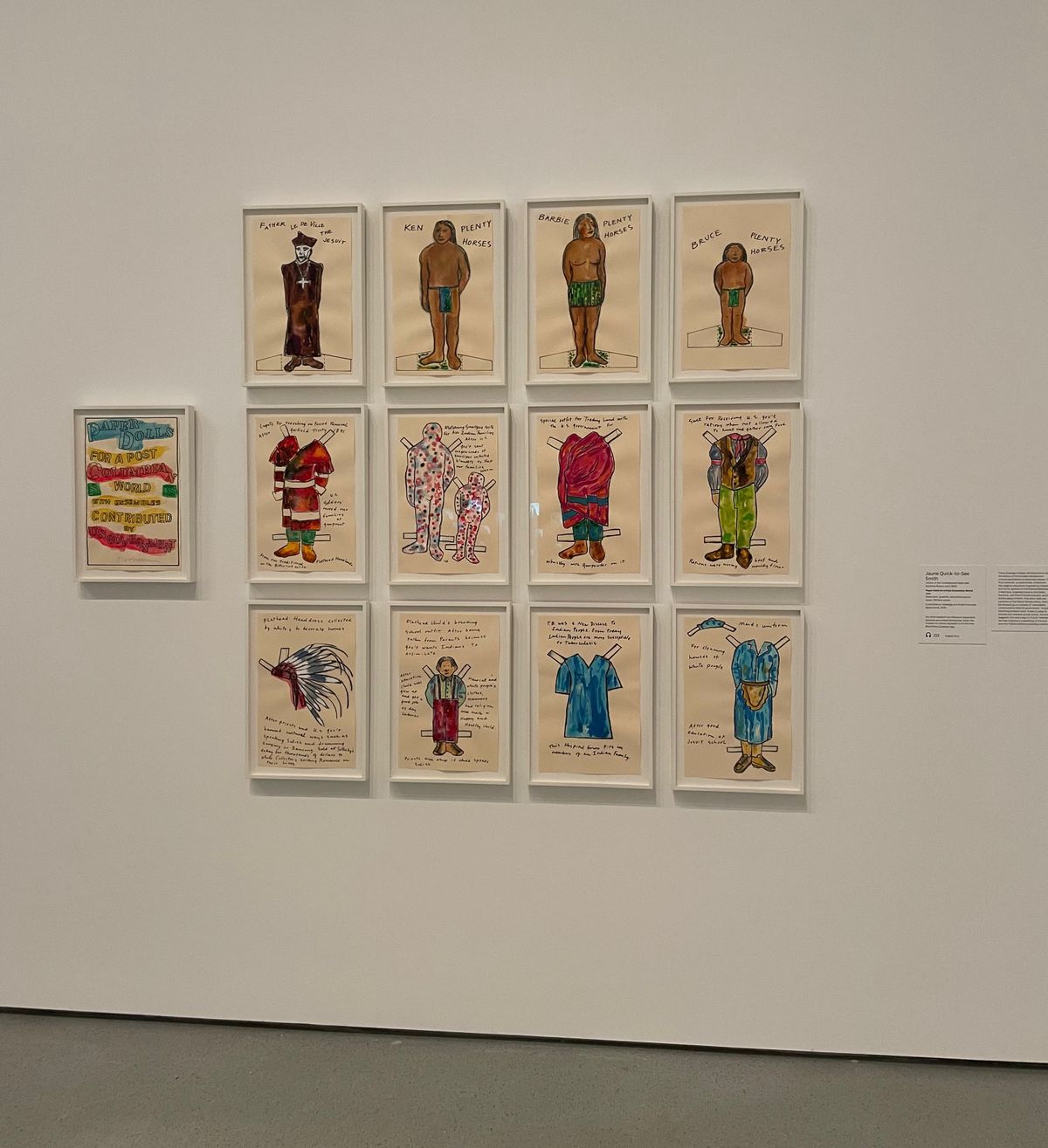
I learned of Jaune’s passing today while I was at MoMA, so I went down to the second floor galleries, where some of her paper cutouts are currently on view.
They are not the most famous of her works, but these were produced around the 500 year anniversary of Columbus’s “discovery” of the “New World,” an irony that Jaune opened up, inhabited—put on—like a paper doll, in those works that are larger than you think—larger than paper dolls, but not larger than life—pieces of paper painted with watercolors in magenta and dark purple, teal and cerulean, with skin a translucent chestnut, with skin exposed but dignified, figures outlined with charcoal, figures in the shape of a priest, a father, a mother, and a child, figures of Indian life in the late nineteenth century, figures of a time that was closer to Jaune’s birth than the span of her life, a time in which the horrors of smallpox and the Catholic Church, the horrors of forced removal and boarding schools and the erasure and assimilation of Natives was not just the norm, but the expected outcome, the responsibility of this United States, a sacred duty it took upon itself in order to save the Indians from themselves (ourselves), and in so doing, attempt to forge a continent in the image of its own deviant dreams, dreams it would deny those subjected to its colonialism, dreams it would explain (it explains so much) as the opportunity for redemption of a people only seemingly lost to history, for their irony, I want to insist, I must insist, is what allows Jaune to see in such devastation such as biting possibility of critique, a possibility for laying bare the truth, the impact, of such policies on the peoples—the government calls them wards, infantile and backwards—the peoples whose land must be stolen for this country to exist, an irony so bright, so potent, so enduring, that we are all living in the wake of its burning glory, a flame, a light that attracted so many, that supported so many, that brought to fruition the future dreams of those same ancestors depicted on a paper cut out, as if waiting to spring to life in the present, as if waiting for the right moment to remind the people not of what has been lost, but what remains to be lived, what remains, in the watery substance of a drip and a dot on a paper doll, a drop and a dot, a doll, a dream, a loving memory, a fierce, dedicated, unflinching animator of life.