When Grandma Ada Crashed the ASA
A Haunting in NOLA
I’ve been in New Orleans for the past few days attending the American Studies Association annual conference. I try not to take academic conferences too seriously these days. For me, they are more about the margins, the outside limits of the official event. Which is to say: the parties, hallway conversations, and screaming OMG-I-haven’t-seen-you-in-forevers. The gossip.
My kin SJ Norman has been with me here, and we’ve had a good time hanging out, gazing at the oak trees and the Mississippi, walking around, talking, talking, talking. It has been nice to introduce him to some of my academic people.
But what I want to write about is what happened during my panel on Saturday, which was chaired by Susan Stryker, and included Maura Finkelstein, Ian-Khara Ellasante, and me. We titled it “Fungible Landscapes, Haunting Presences: Contesting Settler-Colonial Imaginaries,” and as I note in a previous post, I was supposed to write a paper inspired by my loathing of the Jane Campion film The Power of the Dog. I say I was supposed to because in the end, while I did tidy up my notes on the film into a sort of argument, what I really wanted to do was read a portion of the memoir that I have (secretly, but also not so secretly) been working on. I know, I know. Every queen and her godmother is writing a memoir these days. But I am, and I wanted to read some of it.
I wanted to read some of it because the panel was about how the eroticism of the land is erased in settler colonial films, in settler colonialism writ large. The Power of the Dog erases Indigenous presence by projecting a shadow onto the land (the head of the dog), that serves as a kind of metonymy of settler colonial fantasies of occupation. But TBQH that is a bit boring. I guess it needed to be said, but I wanted to say it and move on. The thing is that I have also described my own relationship with Indigeneity as a kind of shadowing, a haunting. I wanted to resist the narrative of Indigenous erasure—that is, I wanted to fill in the space of the shadow, the place which, for me, is both a possibility and a source of pain, a wound. I wanted to resist that by reading not a critique of a film, but a description of how I met my Grandmother Ada for the first time, in 2006, when I was 23 years old.
So there I was, reading a portion of the thing that I’ve been calling a memoir, and I’m describing the trip my family took to Lubbock, where we met Ada, my grandmother, my father’s mother, for the first time since she gave my father up for adoption in 1952.
And as I said the word Ada for the first time, the lights went out. Not just in our small room, but in an entire section of the hotel.
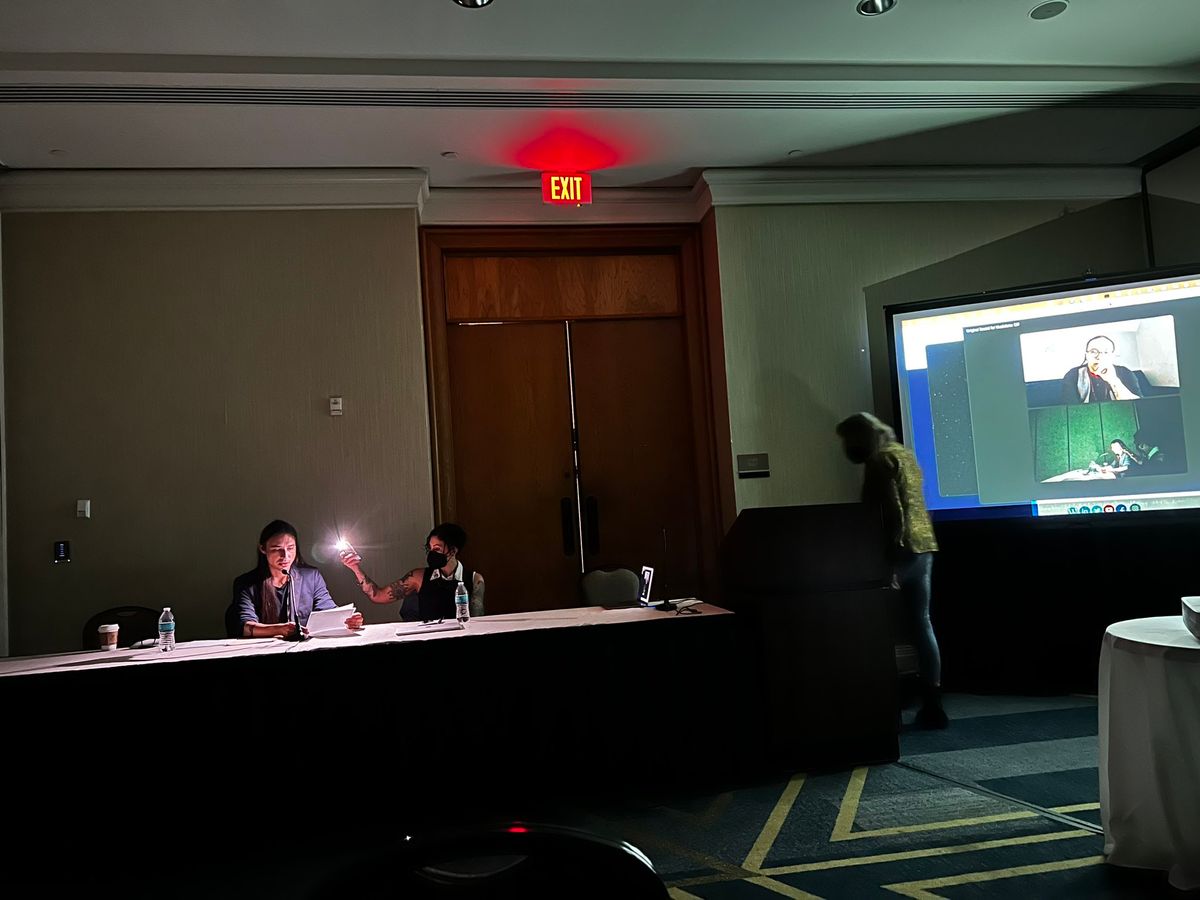
I waive my arms thinking that it is a sensor that controls the lights and we haven’t been moving enough for it to register that we are still there in the room. But nothing. A flicker. And then again the lights are out. Susan gets up and tries to see what is going on, but I’m in the middle of a paper and the mood has been set, and if I wait too long I’ll lose it. My co-panelist, Maura, had the wherewithal to take out her phone and turn on the flashlight. She lit my text so I could keep on reading.
On a panel about hauntings, while reading a paper about hauntings, in a city of hauntings, surely this is no coincidence. It reminds me of what Sebastián Calfuqueo said to SJ and me once: “we are indios, we don’t believe in chance”. Surely not.
I finished reading my paper about Ada in her presence. I finished reading a part of me that is about a part of her, the part that I was able glimpse for the first time over fifteen years ago. That moment, an illumination. An opening up onto a life that I would only later realize is also a shadow, a memory before embodiment. An inclination, like love, like spirit.
And then, to my great surprise, Zein Murib, who was in the audience, posted a photograph on Twitter of the exact moment when Maura was lighting my way, when I was calling Ada’s name, with Susan and Ian-Khara suspended in time.
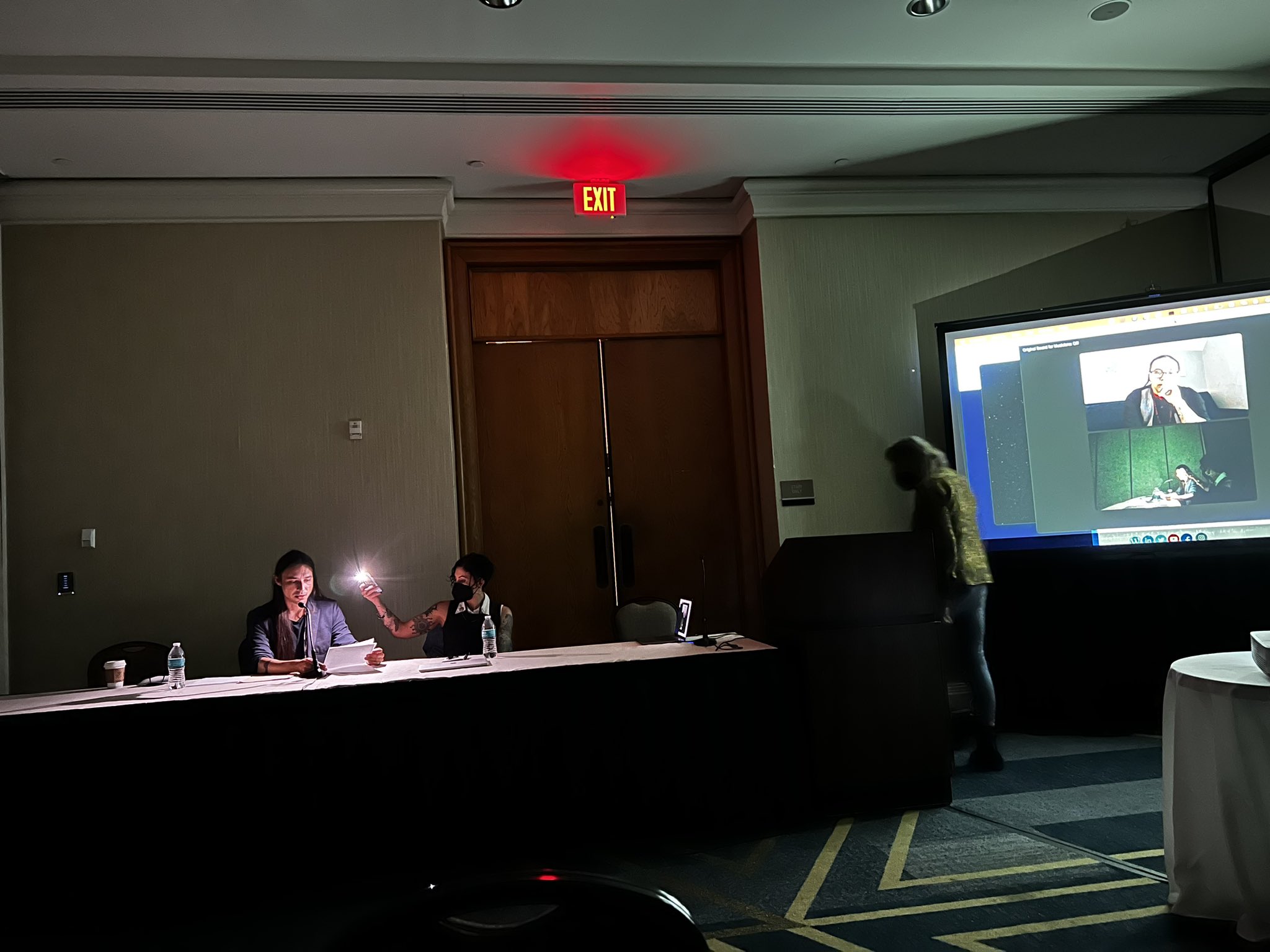
(Photo Credit: Zein Murib)
It is a marvelously composed image. The table dividing the lower plane. Susan walking past the screen. Ian-Khara at the upper right. The glow of an exit sign above. Maura holding a phone, lighting my face, the paper, casting a shadow across the table.
I want to remember this moment. And I fear that without this photograph, I would lose it. I fear that everything I want to remember seems to fade, to dissolve into the longing that is NDN life under settler colonialism. So I am grateful to Zein for this gift, to Maura for this kindness. To Ada for showing up and reminding me that she is always with me.